


It didn’t always march down Rajpath
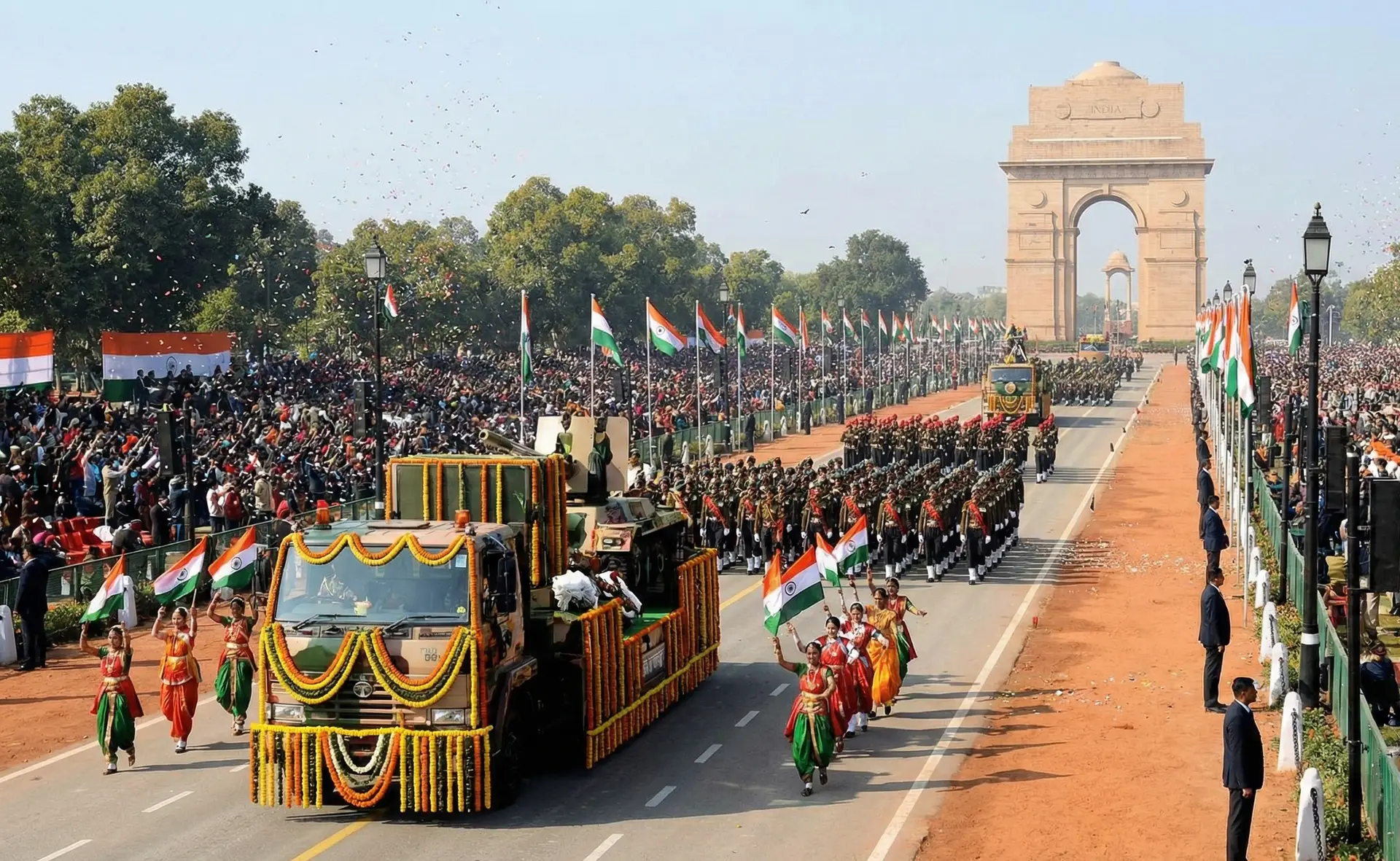
The very first Republic Day parade in 1950 was held at Irwin Stadium (today’s National Stadium).
Over the next few years, the venue shifted—Kingsway (Rajpath), Red Fort, even Ram Lila Grounds—before settling permanently on Rajpath as ceremonial logistics improved.
🎖️ The President once arrived on horseback
Until 1980, the President of India arrived at the parade on a horse-drawn carriage—a direct inheritance from British ceremonial customs.
The switch to a motorcade wasn’t about modernity alone; it was driven by security reassessments after global political assassinations in the 1970s.
🌍 The Chief Guest tradition is strategic, not symbolic
Inviting a foreign leader isn’t just pageantry—it reflects India’s current diplomatic priorities.
Some lesser-known patterns:
- 1950s–60s: Focus on post-colonial and non-aligned nations
- Cold War era: Balancing superpowers
- Recent decades: ASEAN, Africa, and strategic partners
In 1965, due to the Indo-Pak war, no Chief Guest was invited—a rare break from tradition.
🧵 Tableaux were once hand-pushed
Early state tableaux were manually pulled or pushed—no engines.
Motorised tableaux became standard much later, and even today they must meet strict speed, noise, and emission limits so marching contingents remain synchronized.
Behind the scenes, each tableau goes through multiple rejection rounds, often redesigned 2–3 times before final approval.
🎶 The parade’s music isn’t randomly chosen
- Marches are selected to match precise step counts
- Bands practice months in advance to ensure every beat aligns with troop movement
- Many tunes date back to pre-Independence regimental traditions, quietly repurposed for a republic
🧑🤝🧑 Not just soldiers: civilians marched first
In the early years, schoolchildren, folk artists, and civil groups formed a larger part of the parade than armed forces.
The increasing military prominence reflects India’s evolving security environment—not a shift away from culture, but an expansion of the parade’s purpose.
🌸 Flowers on Rajpath are laid overnight
The floral patterns you see aren’t placed days earlier—they’re arranged the night before, often between midnight and dawn, to ensure freshness and symmetry for live broadcast.
🎖️ Gallantry awards were once announced during the parade
In the 1950s, some gallantry awardees were publicly introduced at the parade itself, not separately as today.
The process was later formalized to preserve solemnity and protocol.
🎺 The parade doesn’t end on 26 January
The Beating Retreat ceremony—held a few days later near Vijay Chowk—is the actual formal conclusion of Republic Day celebrations.
When the final bugle call sounds and lights fade, it marks the military’s symbolic return to barracks.
🧭 Evolution without losing its spine
What’s remarkable isn’t just how the parade has changed—but how it has retained continuity:
- Colonial rituals → republican symbolism
- Regional folk traditions → national storytelling
- Static display → live global broadcast
It’s one of the few ceremonies where state power, civilian culture, and constitutional identity meet on equal ground.